

Introduction to Computer Networks
A computer network is a group of connected devices that exchange data and share resources using agreed rules called protocols.
What a Computer Network Does
A network lets independent devices communicate. The devices may be laptops, phones, servers, printers, sensors, or routers. A connection may use copper cable, fiber, or radio waves.
The connection alone is not enough. Both ends must follow the same protocol so they agree on message format, timing, addressing, and what to do when something goes wrong.
- Communication: send messages, calls, files, and video.
- Resource sharing: use shared printers, storage, and internet connections.
- Remote access: reach applications and data from another location.
- Distributed work: let many computers cooperate on one service.
The Parts of a Simple Network
Every communication has a sender, a receiver, some data, a path, and a protocol. A web request, for example, travels from a browser to a web server through several links and devices.
Networks by Geographic Coverage
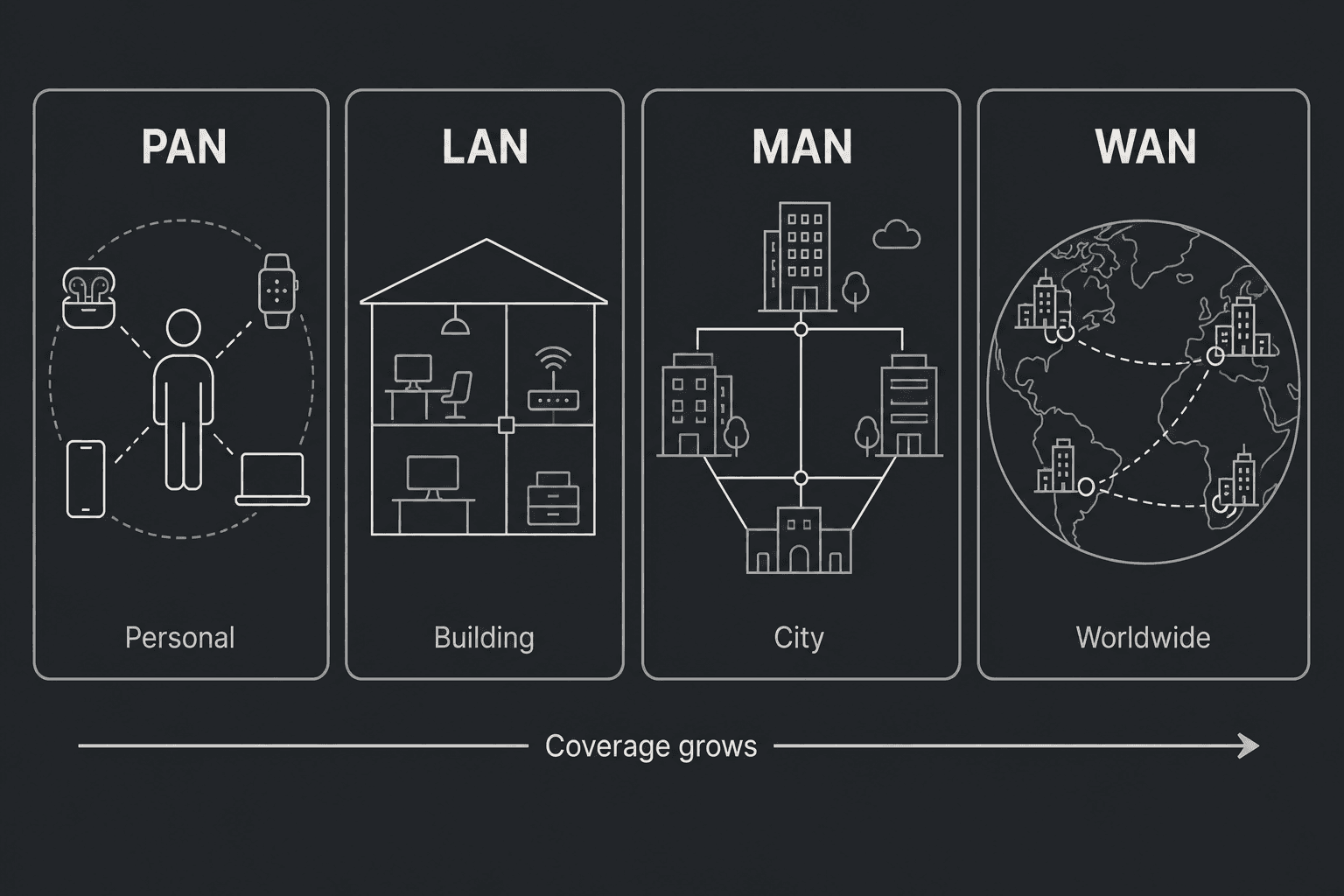
Network names often describe the area they cover. The border is not always exact, but the classification helps us compare typical size, ownership, and purpose.
| Type | Typical area | Example | Usual ownership |
|---|---|---|---|
| PAN | Around one person | Phone connected to earbuds | One person |
| LAN | Home, lab, or building | College computer lab | One home or organization |
| MAN | Town or city | City-wide campus network | Provider or large organization |
| WAN | Country or worldwide | Bank branches across India | Several providers or organizations |
Internet, Intranet, and Extranet
The Internet is the public network of interconnected networks. No single organization owns the entire Internet. Many independent networks cooperate through the TCP/IP protocol suite.
An intranet uses network and web technologies inside one organization. An extranet gives selected outsiders, such as suppliers or customers, controlled access to part of that private system.
How We Judge a Network
A fast network is not automatically a good network. We also care about whether it stays available and whether it protects its users and data.
- Performance includes delay, throughput, and response time.
- Reliability includes failure rate, recovery time, and alternative paths.
- Security includes confidentiality, integrity, authentication, and availability.
- Scalability means the network can grow without a large loss of performance or manageability.
Bandwidth, Throughput, Delay, and Loss
These terms describe different parts of network performance. Bandwidth is the maximum capacity of a link, while throughput is the useful rate actually achieved. A high-bandwidth link can still feel slow when delay, congestion, or packet loss is high.
| Term | Simple meaning | Common unit |
|---|---|---|
| Bandwidth | Maximum data-carrying capacity | bit/s, Mbit/s, Gbit/s |
| Throughput | Rate of successfully delivered data | bit/s, Mbit/s, Gbit/s |
| Latency | Time taken for data to travel | ms |
| Jitter | Variation in packet delay | ms |
| Packet loss | Packets that never reach the destination | Percentage |
Direction of Communication
Communication can also be classified by which side is allowed to send. This is different from client-server roles: a client-server application can use a full-duplex transport connection.
| Mode | Direction | Example |
|---|---|---|
| Simplex | Only one side sends | Traditional keyboard to computer |
| Half-duplex | Both sides send, but not at the same time | Walkie-talkie |
| Full-duplex | Both sides send at the same time | Phone call or switched Ethernet |
How a simple network exchange happens
- 01An application creates data, such as a request for a web page.
- 02The sender follows network protocols to identify the destination and prepare the data for transmission.
- 03Links and intermediate devices carry the data toward the destination.
- 04The receiver interprets the data using the same protocol rules.
- 05The receiver may return a response through the network.
Example
Opening a page on college Wi-Fi
Your phone creates a web request and sends it over Wi-Fi to an access point. The local network forwards it to a router, and provider networks carry it to the website's server. The server returns the page data through the same interconnected system, although the exact return path may differ.
A common mistake
The Internet and the Web are not the same thing. The Internet is the network infrastructure. The Web is one service that uses it, mainly through HTTP and HTTPS.