

Introduction to Databases and DBMS
A database stores related data in an organized form. A Database Management System, or DBMS, is the software that lets applications store, find, change, protect, and recover that data.
Data and a Database
Data means recorded facts. A student's name, roll number, course, and marks are data.
A database is an organized collection of related data. It is normally persistent, which means the data remains stored after an application closes. A college database may keep students, teachers, courses, and marks together because these facts belong to the same system.
What Is a DBMS?
A DBMS is software placed between applications or users and the stored database. Applications send requests to the DBMS instead of changing stored files directly.
MySQL, PostgreSQL, Oracle Database, and Microsoft SQL Server are examples of DBMS products. The product is the DBMS; the organized data managed by it is the database.
Applications, administration tools, and database users can send requests to a DBMS. SQL is the common language used to send many requests to a relational DBMS.
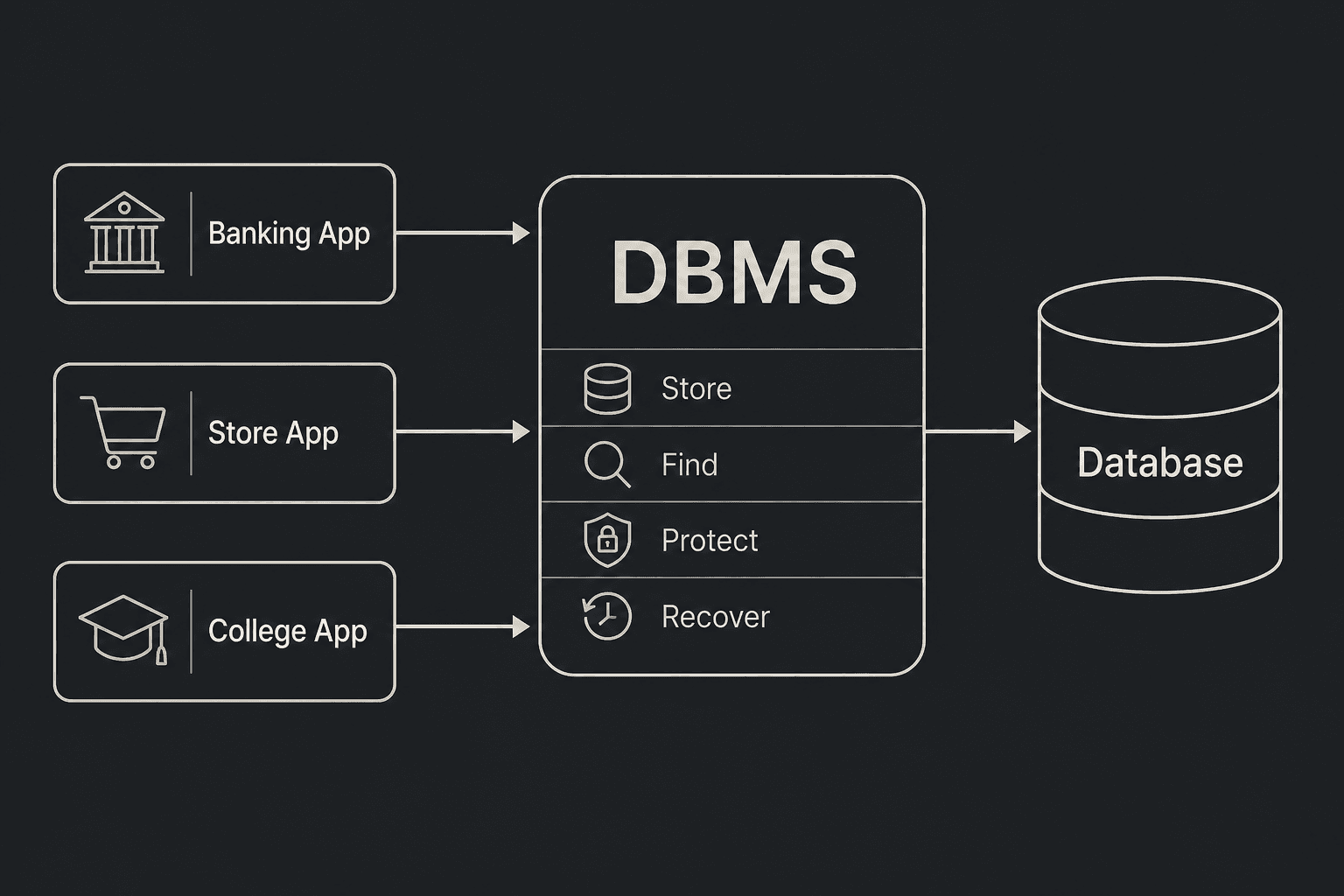
The Main Work of a DBMS
A DBMS does more than save rows. It controls how data is described, used, and protected.
- Define structure: create tables, fields, relationships, and rules.
- Store and retrieve data: add records and answer queries.
- Update data: change or remove records while following rules.
- Control access: allow only approved users and actions.
- Handle concurrent work: coordinate users who access the same data together.
- Support backup and recovery: restore correct data after a failure.
What Is Metadata?
Metadata is data that describes other data. It tells the DBMS what the database looks like.
For a Student table, metadata can say that RollNumber is an integer, Name is text, RollNumber must be unique, and CourseId refers to another table. The student rows are data; these descriptions and rules are metadata.
The DBMS keeps metadata in a system catalog, also called a data dictionary.
DBMS and RDBMS
DBMS is the broad name for software that manages databases. An RDBMS is a DBMS based on the relational model, where data is organized as related tables.
MySQL, PostgreSQL, Oracle Database, and Microsoft SQL Server are relational DBMS products. The relational model is explained properly in the next module.
How a simple database request works
- 01A user performs an action in an application.
- 02The application sends a request to the DBMS.
- 03The DBMS checks the request, permissions, and database rules.
- 04The DBMS reads or changes the stored data.
- 05The DBMS returns a result or reports an error.
Example
Checking a bank balance
A banking app asks the DBMS for the balance of one approved account. The DBMS checks access, finds the account record, and returns the balance. The app displays it; the app does not search the storage files itself.
A common mistake
A database and a DBMS are not the same. The database is the organized data; the DBMS is the software that manages it.