

Introduction to Deep Learning
Deep learning is a part of machine learning that uses neural networks with several layers. These layers learn useful patterns directly from examples.
Start With the Main Idea
A machine-learning model learns a relationship between input data and a target. Deep learning does the same job, but it uses a layered neural network to build the relationship.
The word deep refers to the number of learned layers between the input and output. It does not mean that the model thinks like a person or understands the world in the human sense.
AI, Machine Learning, and Deep Learning
Artificial Intelligence is the broad goal of making computers perform tasks that appear intelligent. Machine Learning is one way to reach that goal by learning patterns from data. Deep Learning is a family of machine-learning methods based on layered neural networks.
A deep-learning model is therefore also a machine-learning model. The terms are related, but they are not interchangeable.
| Area | Main idea | Example |
|---|---|---|
| Artificial Intelligence | Broad field of intelligent computer behaviour | A system that plans a route |
| Machine Learning | Learns a pattern from examples | A model that predicts house prices |
| Deep Learning | Uses layered neural networks | A network that recognizes objects in images |
Traditional Machine Learning and Deep Learning
In many traditional machine-learning systems, people decide which useful features to calculate before training. A deep network can learn several levels of features from the supplied numerical input.
This is a difference in approach, not a strict rule. Traditional models can also learn representations, and deep-learning projects still require people to prepare data and choose a useful objective.
| Question | Traditional ML | Deep Learning |
|---|---|---|
| Features | Often designed or selected by people | Many features learned through layers |
| Common data | Structured tables | Images, text, audio, and other complex data |
| Model depth | Usually fewer learned transformations | Usually several learned transformations |
What Is a Learned Representation?
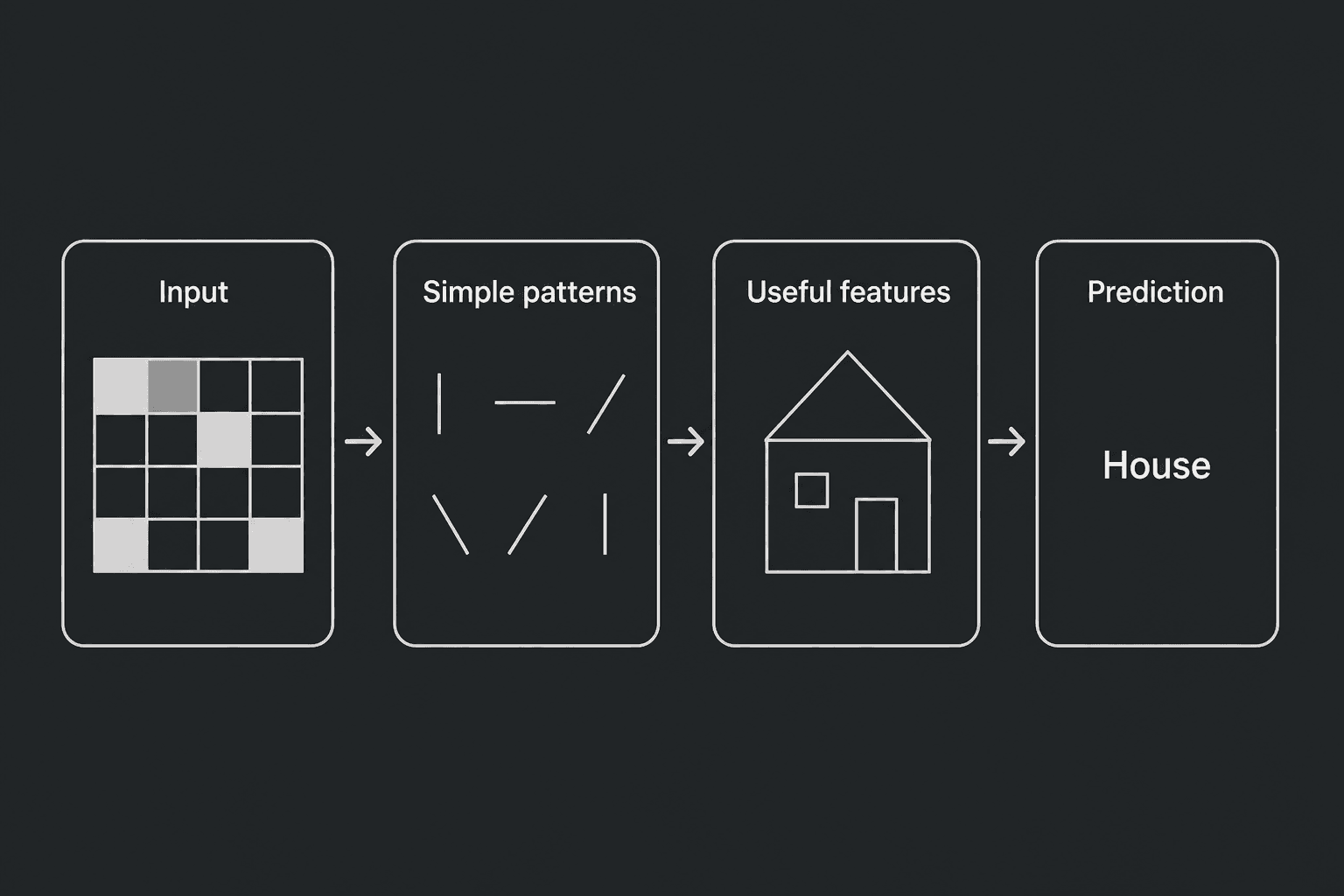
Raw data is often not in the most useful form for a prediction. A representation is a useful internal description of that data.
For an image, early layers may respond to edges. Later layers may combine edges into shapes. Deeper layers can combine shapes into object parts. The final layer uses these learned features to make a prediction.
The important point is that the programmer does not manually write every feature rule. Training adjusts the network so that useful features emerge from the data and the learning objective.
When Deep Learning Is Useful
Deep learning is especially useful when the data has complex structure and enough useful examples are available. Images, audio, text, and long sequences are common cases.
It is not automatically the best choice. A small structured table may be handled well by linear models or tree-based models. These models can train faster and may be easier to explain.
Training and Inference Are Different Stages
During training, the network makes predictions, measures error, and adjusts its parameters. During inference, the trained parameters stay fixed while the network produces an output for a new input.
Validation and test examples check whether the learned pattern works on data that did not update the parameters. A good training score alone is not enough.
Important Limitations
A neural network learns statistical patterns in its training data. It can repeat bias, use accidental shortcuts, and become confident for unfamiliar inputs.
A high test score also does not prove that a model is safe for every situation. The test data must represent the real task, and important failures must be studied separately.
- Training can require a large amount of data and computation.
- The learned reasoning can be difficult to explain.
- Biased or incorrect data can produce harmful predictions.
- Inputs that differ from training data can cause unreliable outputs.
Practice: Choose the Right Starting Point
The goal is not to choose the most complicated model. The goal is to choose a model that fits the data and task.
Problem 01
Small tabular dataset
A bank has 1,200 rows with ten clearly defined numerical features and needs an explainable baseline. Should it begin with a deep neural network?
- 01Identify the data: a small structured table.
- 02Identify the requirement: the result should be explainable.
- 03Compare the cost: a deep model adds complexity without a clear need.
Answer
No. Begin with a simpler baseline such as logistic regression or a tree-based model, then compare alternatives honestly.
Problem 02
Large image collection
A factory has hundreds of thousands of labelled product images and wants to recognize visual defects. Is deep learning a reasonable choice?
- 01The input is unstructured image data.
- 02Visual defects may require many learned patterns.
- 03A large labelled dataset is available.
Answer
Yes. A deep vision model is a reasonable candidate, but it must still be compared with a baseline and tested on realistic images.
How a deep-learning system learns
- 01Convert each example into numerical input values.
- 02Pass the values through a stack of layers to produce a prediction.
- 03Compare the prediction with the correct target using a loss function.
- 04Calculate how each parameter affected the loss.
- 05Adjust the parameters to reduce future error.
- 06Repeat over many examples and validate on data not used for updates.
Example
Recognizing a handwritten digit
The input layer receives pixel values. Early layers learn small strokes and edges. Later layers combine them into loops and digit shapes. The output gives a score or probability for each digit from 0 to 9.
A common mistake
Deep learning does not remove the need for data preparation, evaluation, or human judgment. It learns useful features, but only from the data and objective it is given.