

Binary Numbers and Place Value
A computer stores information using two stable states. We write these states as 0 and 1. One binary digit is called a bit, and a group of eight bits is called a byte.
Why Binary Uses Powers of Two
Decimal has ten digits, so its place values are powers of 10. Binary has only two digits, so its place values are powers of 2.
Starting from the right, the binary place values are 1, 2, 4, 8, 16, 32, and so on. A 1 means the place value is included. A 0 means it is not included.
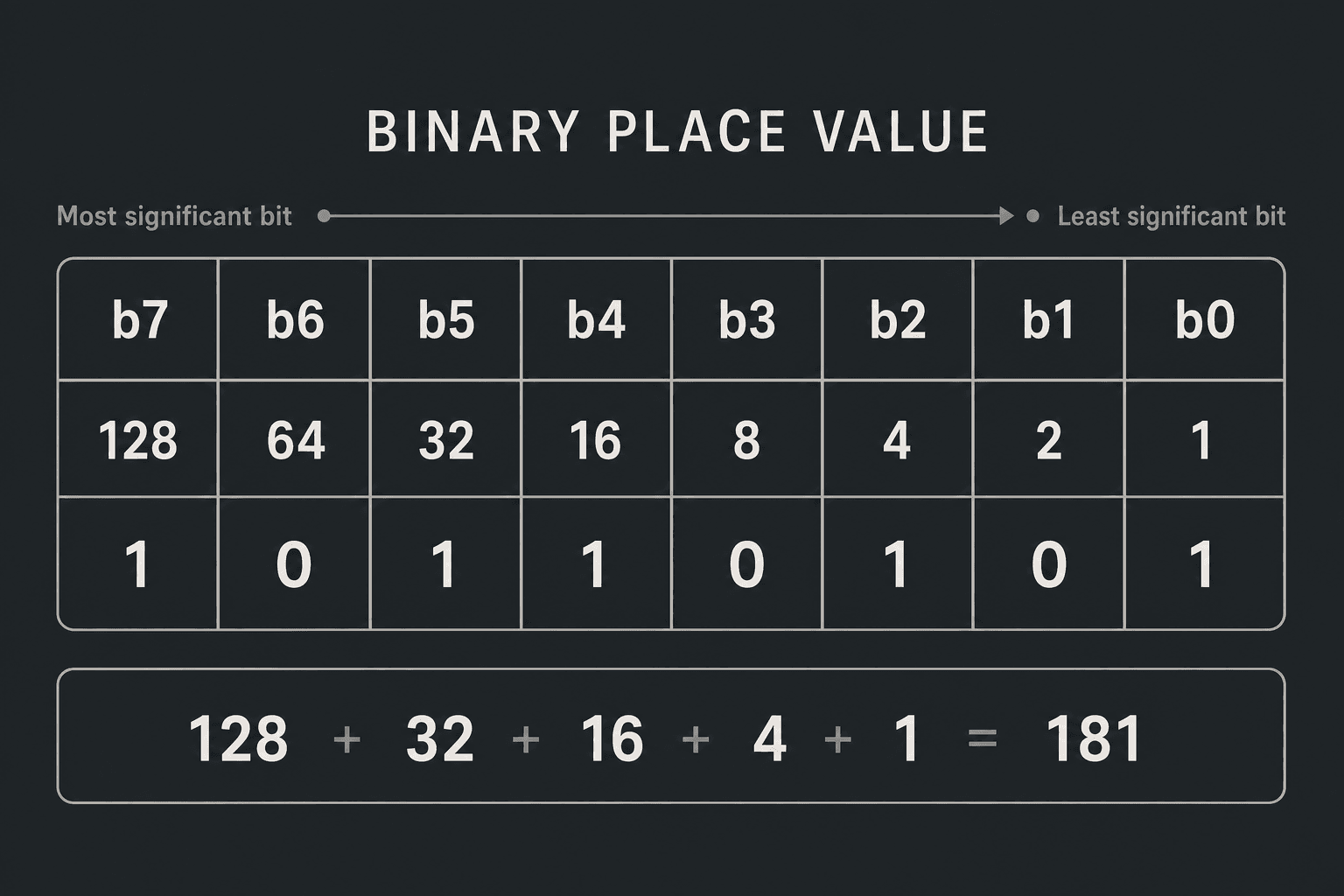
Binary to Decimal
Multiply each bit by its place value and add the results. For 10110101, the active places are 128, 32, 16, 4, and 1.
The symbol Σ means add all the terms. In the positional formula, bitᵢ is either 0 or 1, and 2ⁱ is the place value at position i.
| Bit position | 7 | 6 | 5 | 4 | 3 | 2 | 1 | 0 |
|---|---|---|---|---|---|---|---|---|
| Place value | 128 | 64 | 32 | 16 | 8 | 4 | 2 | 1 |
| Bit in 10110101 | 1 | 0 | 1 | 1 | 0 | 1 | 0 | 1 |
The rightmost bit uses i = 0.
Decimal to Binary
Repeatedly divide the decimal number by 2. Record each remainder. Read the remainders from bottom to top.
Unsigned Range and Bit Width
An unsigned value uses every bit for magnitude. With n bits, there are 2ⁿ different patterns. The smallest pattern is all 0s and the largest is all 1s.
Worked Problems
Write the place values or division steps. This makes the method easy to check and earns method marks in an exam.
Problem 01
Convert binary to decimal
Convert 110101₂ to decimal.
- 01Write place values: 32, 16, 8, 4, 2, 1.
- 02Keep the places whose bit is 1: 32, 16, 4, 1.
- 03Add them: 32 + 16 + 4 + 1 = 53.
Answer
110101₂ = 53₁₀
Problem 02
Convert decimal to binary
Convert 45₁₀ to binary.
- 0145 ÷ 2 = 22 remainder 1
- 0222 ÷ 2 = 11 remainder 0
- 0311 ÷ 2 = 5 remainder 1
- 045 ÷ 2 = 2 remainder 1
- 052 ÷ 2 = 1 remainder 0
- 061 ÷ 2 = 0 remainder 1
- 07Read the remainders from bottom to top: 101101.
Answer
45₁₀ = 101101₂
Problem 03
Convert a larger value and check it
Convert 173₁₀ to 8-bit binary and verify the result.
- 01Choose the largest place not above 173: 128. Remainder = 45.
- 02Skip 64. Use 32, leaving 13. Use 8, leaving 5. Use 4, leaving 1. Skip 2 and use 1.
- 03Write the bits under 128, 64, 32, 16, 8, 4, 2, 1: 10101101.
- 04Check: 128 + 32 + 8 + 4 + 1 = 173.
Answer
173₁₀ = 10101101₂
How to read an unsigned binary number
- 01Write powers of two above the bits, starting with 2⁰ on the right.
- 02Select every place whose bit is 1.
- 03Add the selected place values.
- 04Check that the answer is inside the range for the bit width.
Example
Why 8 bits stop at 255
Eight bits create 2⁸ = 256 patterns. Because counting starts at 0, the values are 0 through 255, not 1 through 256.
A common mistake
The leftmost bit is not always a sign bit. It is a sign bit only when the chosen representation is signed.